
SEO for AI search is a hot topic.Search Engine Land published an article on February 18, 2026, in which it stated that 44% of ChatGPT citations come from the top one-third of the content on the page.
Why is this important? Because we know that AI now dominates search. Many people will not go beyond the ChatGPT or Copilot snippet at the top of their search engine results. AI search snippets have become the new top of funnel (TOFU) content. While we used to build this out on our own websites, now we, as marketers, try to get as many AI snippets and citations as possible. Their snippets have replaced ourTOFU content, and our websites focus onMOFU and BOFU content.
But how do you encourage ChatGPT and Copilot to pick up on your own content, produce it as a snippet, and cite your brand (with a link)? The secret is in the shape – that is, shaping your content by packing useful information into the top of the article, or throughout the whole thing.
This is called the upside-down triangle method of content shaping, when the first paragraph packs the most information. Let’s dive into shaping content for AI search.
The Upside-Down Triangle Paragraph and Its Importance in SEO for AI Search
I first learned about the upside-down triangle in sixth grade. We had a workbook that reproduced paragraphs, and we had to choose which ‘shape’ the paragraph was: a triangle, an upside-down triangle, or a rectangle.
The upside-down triangle pushes the main idea to the top of the paragraph. The topic sentence becomes the lede. In content writing for SEO, we want to put the big idea or key takeaway first.
- The triangle puts the main idea or topic sentence last. It anchors the paragraph, and all the information preceding it builds until it concludes with the big idea. Many of us wrote for theinternet using this formula in the pre-AI days, but in today’s AI-driven search, this writing style will not help your content rank well.
- The rectangle uses every sentence to provide rich details and useful information. No one sentence is more important than the others. All answer the question with different, very useful information. This is actually the most difficult shape to write, yet it does occur. I have found it mostly in scientific and healthcare literature, and somewhat in technology.
When it comes to AI-based search, the goal is to push the most useful, relevant information into the topic sentence and the upper third of the content. Hence, the upside-down triangle wins when it comes to shaping content for AI search.
Good SEO Techniques Still Rule!
I used the example from my own website, Home Garden Joy, to prove that both the basics of good SEO and the upside-down triangle are the most helpful for gaining the top SERP position.
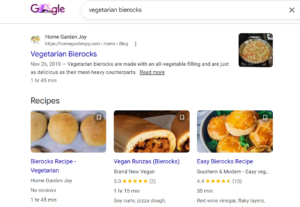 Myrecipe for vegetarian bierocks – an original adaptation of a traditional runza (stuffed dough pocket) recipe – ranks #1 for the keyword: vegetarian bierocks.
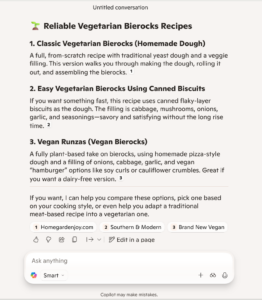
It comes up first in Microsoft Copilot for AI-based snippets or the ‘best vegetarian bierocks recipe’ with a link back to my website, Home Garden Joy. That is pure GOLD in today’s AI-driven search.
It also ranks first in the images in Google for the keyword term, as well as the first article for the same keyword term.
 Why does it rank well?
Traditional SEO Best Practices
I usetraditional SEO best practices throughout the article. I have gone back and revised the original article several times.
- Keywords – I chose a good keyword term. My content on the website is optimized around the keyword term, using H1, H2, meta title, meta description, and so forth, all around the term. The content is not “orphaned” on my site.
- Structure – The recipe is structured in the upside-down triangle method. No rambling stories or gushing tales of how my family loves them. I know why recipe bloggers did this in the past, but it was never my style. Now, in today’s AI-driven search, I believe that such content at the beginning of a recipe or article is detrimental when, in the past, it was helpful to rankings. I go right to the point: what is a bierock, how I made this recipe vegetarian and whole food-plant based, and how it transports and freezes well. Boom, done, into the article.
- Images -In the last update, I took new photos of the finished bierocks, focusing on making them look appealing. Thankfully, the last time I made them, they did come out looking tasty! Adding good alt tags to the images has helped them rank well in Google Image search.
SEO for AI Search
The structure is what makes this blog post appeal to AI search. It’s the upside-down triangle format of the piece. The first several sentences of the article are packed with information directly on the topic of ‘vegetarian bierocks’. This includes the definition of what a bierock is, what makes this recipe vegetarian, and whether it freezes or transports well.
How to Get Your Older Posts to Rank Well for AI Search
I have edited hundreds of blog posts over the years, and I have noticed that many writers “circle the airport before landing the plane”, meaning they take a while to get to their topic sentence. As an editor, I found I could typically cut 1-3 sentences (sometimes entire paragraphs) and finally get to the lede – the topic sentence – and the meatof the introduction.
In order to rank well for the current AI-based search models, you need to cut away all of the fluff at the beginning of your online content and immediately answer the question that is posed by your topic. It doesn’t matter if you’re writing about vegetarian bierrocks or SEO. “The facts, ma’am, just the facts” should be your mantra moving forward.
What About Creative Expression?
I’m glad you brought that up, because I have always felt that ‘writing for the search engines’ limited my creative expression. Even before the advent of AI-based search, I always felt that writing for a keyword phrase limited my ability to cover a topic. I was so concerned about using the keyword correctly and all the stuff that goes along with “SEO writing” that I forgot that SEO writing is simply good writing – writing first for people, and for search engines second.
There are ways you can address this if you truly feel that your creativity is stifled. First, you can add a summary to the start of your article. It should pack all the juicy information at the top. If you are updating older blog posts, that’s a good way to update them without having to delete stories that you love. Keep the story about Aunt Mary’s mashed potatoes, but add an opening summary that addresses why this is the best mashed potato recipe on the internet and the unusual ingredients it contains, and that may be enough to bump it in the SERPs.
Updating Old Posts for New AI-Based Search
Now that you understand this one facet of crafting text for AI-based search, what’s next? What do you do if (like me) you have over 1,000 old posts – and some of them are written in the old let’s ramble on before we start style?
- Download the URLs using Google Search Console. I download mine into a spreadsheet because it is easier to sort and search through the metrics using spreadsheets than trying to find them on Google.
- Prioritize your updates on posts languishing on the second page of Google’s SERPs. These are the posts with promise – but not with so much traffic that you jeopardize their position if you make a mistake during the update.
- For each post, research the current trending keywords and competitors’ articles. What should you add to yours to improve it?
- Read with a critical eye. Do you “circle the airport without landing the plane” in prose, or ramble on without getting to the point? Adding summaries packed with information helps, or pruning back your text (your choice).
- Add FAQs, if appropriate.
- Update internal links and check all links to make sure they aren’t dead-ending in a 404 page not found error.
- Make sure your post isn’t orphaned. It’s amazing how many blogs are filled with posts that aren’t linked from anywhere else on the website, making them orphans – effectively invisible to search engine crawlers.
- Check your images. Did you license them properly? If not, go back and either remove them or license them now. If you took them yourself, can they be improved? My bierocks article benefited greatly from new photos. You may find your articles do, too. I have found that search engines seem to like original photographs.
Get Help with Big SEO Update Projects
Seven Oaks Consulting tacklesSEO updates for AI search. It’s ideal for companies that want to improve their presence in AI search but lack the resources to do it themselves. We’d love to speak with you further. Contact us today about updating older posts for new AI-based SEO.